On a Thursday morning, two women are walking their dog and toddlers down the steep switchback from Puget Park into the gulch below. Framed by native shrubs and cleared understory, they laugh and chat, the dog sprinting ahead in canine heaven. The trickle of a clear stream a hundred feet below mingles with birdsong fifty feet up in the canopy of thick evergreens.
It’s a picture of park perfection, the happy ending to a story of a gulch that fell into ivied disrepair, became the neighborhood dump and saw a child raped and murdered. It’s a tale of how partnership between City, parks and citizens can create a safe and beautiful public place.
But it’s also an ongoing story of the delicate balance between park and habitat, between the safe and the wild, and of how much Tacoma wants of one or the other.
“We’d been in the house one year when the murder happened,” says Walker, who moved with her family 30 years ago to a house directly overlooking Puget Gulch.
Half a block from Walker's home 12-year-old Michella Welch was abducted one March morning in 1986 and killed down in the gulch. Walker had young kids of her own, and started a local children’s safety group, working with Metro Parks to make things safer.
“There was no fence, just a drop-off,” says Walker of the upper park.
The murder was just one of Puget Gulch’s problems 30 years ago. Once a salmon stream fished by local tribes, it was donated to the city in 1888 by early developer Allen Mason, who also built the lamp-posted Proctor bridge for his streetcar line. At the time it was prized for its woods and fresh springs.
But like many of the other gulches, settlement wasn’t kind to Puget. Ivy and blackberry crept down out of yards on the lip above and strangled trees and undergrowth. Transients – like Michella Welch’s still-unidentified killer – found the hidden, dry recesses under the bridge perfect for camping out. (They still do: Police recently routed out an eight-person camp.) Locals used the bridge to toss off old appliances and junk. College students used the depths for parties and hazing rituals. The stream stank like sewage.
And while Walker would use it to walk her dog and take a shortcut to the waterfront – otherwise a long trek down winding, narrow North 36th Street – she never let her younger kids play down there.
What turned Puget Gulch around was a public-private partnership that many see as the way to tame Tacoma’s other wild gulches.
“I’ve been working down here since 1997,” says Scott Hansen, acting executive director of Puget Creek Restoration Society. “It was really hammered with invasives and trash.”
An ecologist who grew up playing in similar gulches in Federal Way and Des Moines, Hansen founded the society in 2000 after meetings with the community. Now the non-profit group partners officially with Metro Parks (most of the gulch is City property) to take out invasives, plant native vegetation, clear the stream bed and paths, take out trash and generally give some love to the gulch.
Hansen’s down there almost daily; his pool of volunteers and interns work there every weekend. Metro Parks does the heavy lifting, and Hansen occasionally brings in Eagle Scouts to install hardware like the switchback’s benches and log steps. This summer, they’re planning a boardwalk project giving park users more access across the stream in the lower reaches.
Hansen even works on restoration with private property owners, who make up a quarter of the upper gulch.
See what Scott Hansen's team has done to restore Puget Gulch.
The result is tangible. From the foot of the bridge a wide gravel trail cuts along between hillside green with lush fern brakes and shaded with conifers. Ivy is rare – though you can see the old dead vines still lashing trunks – and colored ribbons flutter where Hansen’s team have replaced blackberry slopes with little saplings of Indian plum, flowering red currant, salmonberry.
Little paths wind off across the bubbling stream like invitations to explore; fallen trees make tightrope bridges; banana slugs creep along the muddy undergrowth.
And way up the waterfront end, where Puget Creek gets deeper and feeds into Puget Sound via a pipe with a fish ladder, Hansen’s even recorded salmon returns eight out of the last 16 years, plus beavers and otters.
For those who use it, Puget Gulch is a gift.
“I get a sense of peace and relaxation (in the woods), especially down here,” says Sal Greenberger, who walks the gulch regularly with his dog Cedar. “It’s nice to be a little separated from the roads. It usually feels pretty safe, though I never walk late at night.”
“I think it’s wonderful,” says Julie Vindivich, who’s lived just west of the bridge for 15 years now, and remembers when it was still a “neighborhood dumping ground.” She frequently uses the gulch as a shortcut to the waterfront, and loves that her kids have a playground like this. “I grew up on South Hill, where…we’d just explore and explore as kids. It was a magical way to be as a kid that I don’t think they have now. There are parks, but that’s different.”
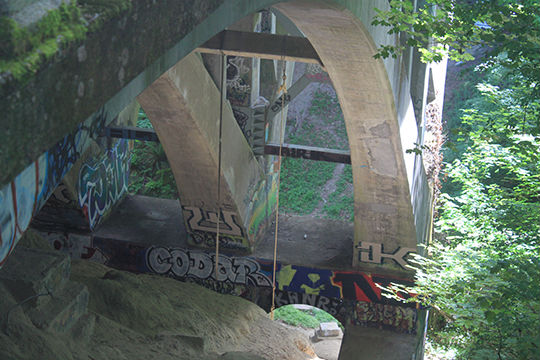
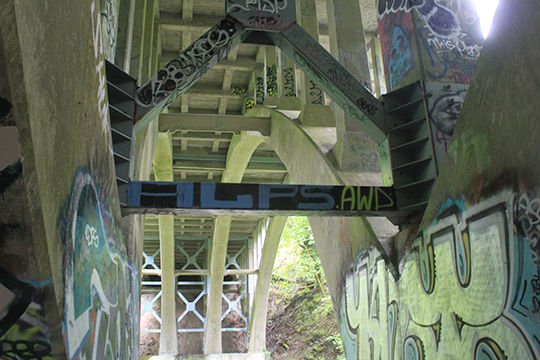
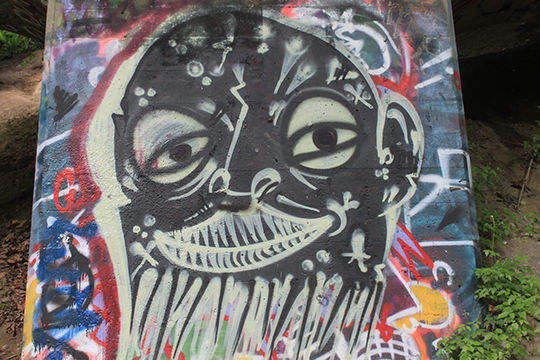
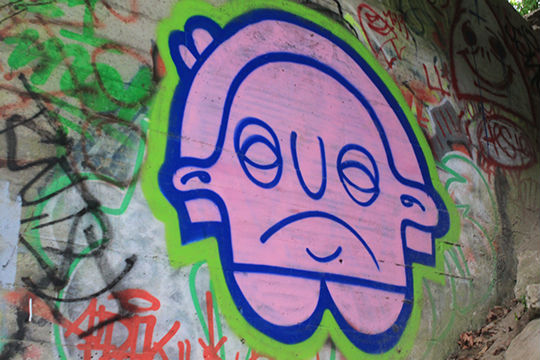
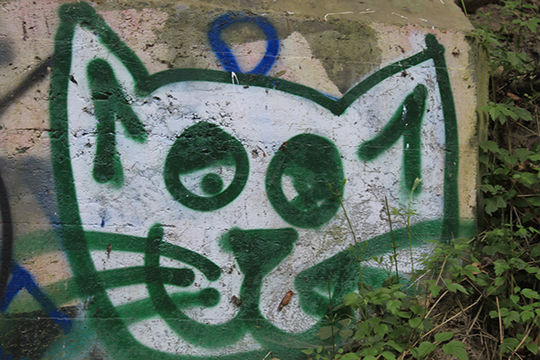
But it’s that difference between a park and something wilder that keeps Puget Gulch in a state of flux. Up the top end, the gravel track gets narrower and less maintained. Huge graffiti faces stare down from the bridge’s supports like menacing guardians, and local teenagers have put up some long rope swings to play on.
“It’s a pretty good place for artists to come; no-one bothers you,” said one teenage graffitist.
Some graffitists also leave a healthy scattering of trash, which Hansen says he doesn’t bother to pick up anymore – vandals just push the bins over or set them on fire. Local police regularly rout out transient camps, he adds. Further up, another group had engineered a mountain bike course complete with six-foot jump pits, ramps and jumps, before the city leveled it. Two paths lead up to Monroe Street at the upper end, but they feel secret, hidden from the street. A live maple grows right across the path at head-height – perfect for bouncing on.
The rope swings.
Kids climb high under Proctor Bridge.
Graffiti under Proctor Bridge.
Graffiti under Proctor Bridge.
Graffiti under Proctor Bridge.
1 – 5
<
>
And for those with sharp eyes, someone has swung a sign 30 feet up into a tree, just off the trail east of the bridge. On one side it says “Bill’s (Semper Vivum) Trail,” on the other, “60 Fysh." Hansen still hasn’t figured out how to get it down.
The waterfront end has its own wild areas, like the ruins of the Skupen residence, donated 30 years ago to Metro Parks. The historic house was demolished, but the laurel and box hedges remain, with stone garden edgings and red azaleas gradually fading into the natural wetland with a silent, haunted feel. A salmon sculpture stares bizarrely through the trees. There's even a hidden pond, if you know where to look.
Some locals don’t want a wilderness. Leah Walker points out pine trees that Hansen has planted just feet from the road. If they don’t die from lack of water, they’ll cut off all views and further darken the gulch, she says. More undergrowth will also encourage the deer, coyote, raccoons and even great blue herons who eat up gardens and pets.
Plus, teens already smoke enough pot in the gulch for Walker to keep her windows closed.
“It’s a fine line,” Walker says. “It’s an urban area. Maybe it’s nice to have a nature preserve in the middle of the city, but how does that impact the neighbors?”
For Hansen, though, it’s still too much of a park.
“We do studies, and there’s low diversity on frogs,” he says. “We’re missing half the bat and half the salamanders that should live here…We don’t have many natural areas left in the city. So we have to restore them and protect them for what wildlife we do have left, versus the manicured parks which are for people. (It’s about) keeping it wild.”
Text, photos, video and design by Rosemary Ponnekanti
Puget Gulch
Access
Walkable track down from Puget Park, 3111 N. Proctor St. ADA-accessible gravel path along floor of gulch from North 36th Street at Ruston Way. Two steep tracks lead out of the upper gulch's north fork to Monroe Street at North 33rd and 34th Streets.
Tips
Wear walking shoes. Stay on the path to preserve restoration efforts. Salmon chum sometimes live under the bridge on the waterfront end, but are hard to find.
Helping
Volunteer with Puget Sound Restoration Society (253-779-8890, pugetcreek.org) on Saturdays from 9-11 a.m.
Explore + Restore
Scroll for trails
Mouse for sights
picnic tables, salmon bridge
log bridge
graffiti, rope swing
bouncing maple
Puget Park and switchback trailhead