Mason Gulch doesn’t look promising. A handful of steep tracks tumble down a jungly slope on the upper end, near the Stevens Street roundabout. Down the waterfront end, the mouth is solidly blocked by a sewage treatment plant. But there is a way in, along a jagged fence line – and when you discover it, you realize that Mason’s inaccessibility has turned this wide gulch into a hidden paradise of native plants, gushing springs and birdsong.
But that may all be about to change. With a 2012 sewer rate increase, the City of Tacoma now has around $300,000 per year to maintain open spaces that drain storm water – and has just signed the first of many agreements with Metro Parks to restore the areas for public use also. The April parks bond also adds to the maintenance coffers. After a year developing a plan for the Schuster slopes near Garfield Gulch, Metro Parks will begin the plan for Mason.
“It’s an awesome opportunity to create access from the neighborhood above to our world-class waterfront down below,” explains Joe Brady, natural resources manager at Metro Parks. “Just like what we’ve done at Puget Gulch.”
It’s ironic that Mason is one of the first candidates for the partnership revamp. For decades the City of Tacoma has had minimal hands-on contact with most of the gulch: After the sewage treatment plant was built in the 1960s at the gulch’s mouth, to take advantage of the fast-flowing water of Mason Creek for washing down treatment tanks, the land has been mostly left to itself, apart from a once-yearly mowing of the access road and a trimming of the thick tree canopy in the 1990s.
It’s the only North End gulch that has no sewer or storm lines running through it. Plant workers go in a couple of times a year to clear vegetation, and occasionally dredge the large, crystal-clear stream pond that feeds that catchment on the plant’s south side before flowing under it out to Commencement Bay.
Other than that, Mason Gulch feels untouched. The fence line west of the plant – city property – is rough to hike. And as you wander down the broad access path, the grass just keeps getting higher, the salmonberries thicker and the quiet more intense. Hawks keen high above. Insects buzz, slugs wander, and the rippling noise of the stream – completely hidden by undergrowth, and impassable – pervades the serene stillness. Wider than most of the other gulches but just as deep, Mason feels like a huge, forested cathedral.
One person who does come up here is Dave Clark, a senior operator who grew up in the North End and has worked at the plant for 26 years.
“Nobody else really goes up here,” says Dave, as he unlocks the plant gate and starts through the grass. “I never see any kids. There used to be this old guy who came down the track from up on the street and would pick up trash, but I haven’t seen him in awhile.”
Now, there’s no trash to pick up – a clue that even teenagers don’t come down this gulch much. What there is here is urban history. A cedar stump, burned out in the fires that ravaged this area back in logging days, is now a home for woodpeckers. Another stump far across the stream bears a smooth, rectangular cut-out used, thinks Clark, by last century’s loggers to slot in a springboard to help them hand-saw logs.
At the end of the path, where brambles make it impossible to find the steep track up to North 37th Street, an abandoned well cap standing amid a field of feathery horsetail like a rusty Roman ruin, with a few mossy tires for effect.
Video: Walk down Mason Gulch with Dave Clark.
Two rusted metal barrels. A mysterious concrete bunker, now a ferny grotto roofed over by a still-leafy fallen maple. There’s even a car somewhere by the stream that went over the edge in the 1980s and is now engulfed in vegetation.
And Clark’s special find: an ancient pipe, covered with moss and rust, wedged into the hillside just a little ways in and spouting clear water – one of Mason’s many springs, tapped a hundred years ago.
The cool water tastes unbelievably fresh.
“An old neighbor who worked for the Water Department for over 40 years once told me it served as a drinking water source for the immediate area until the end of World War 1,” remembers Clark.
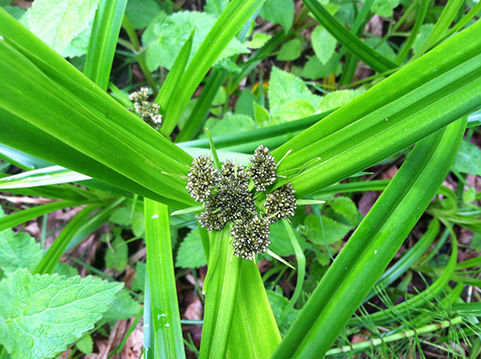
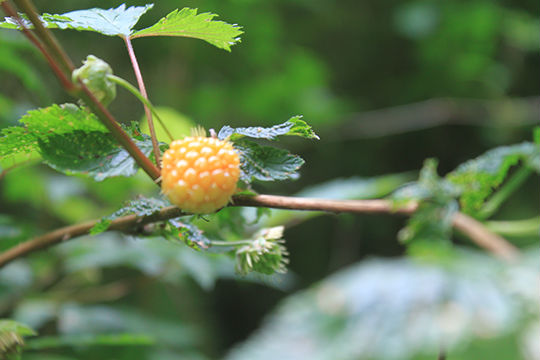
Small fruited bullrush.
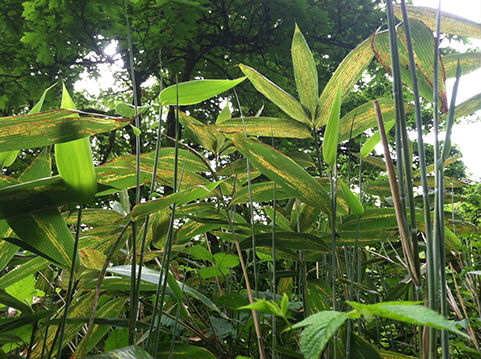
Bamboo.
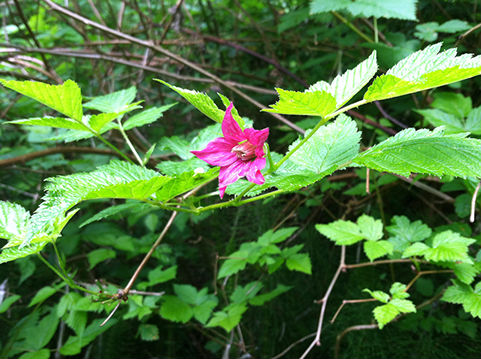
Salmonberry flower.
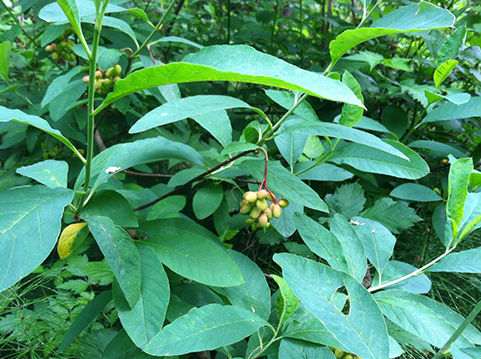
Indian plum.
Salmonberry.
1 – 5
<
>
But the other huge thing Mason has in its favor is the vegetation. Despite the soaring maples – a scourge to residents like David Seal, who regularly petition the council to trim them back to preserve views – and despite Mason’s history as a logging site, there are still quite a few conifers.
Underneath them, the tangle of invasives like ivy and blackberry that threaten other gulches like Garfield and Buckley are absent – instead, there are swathes of horsetail and reeds, salmonberry and thimbleberry ripening tart in the sun, Indian plum, red currant, native nettles. It’s a perfect home for deer, raccoons, otters, squirrels, coyote, even (once) a fox – not to mention hundreds of insects and birds.
“(Mason’s) in much better ecological shape than the other gulches,” Brady says. This time next year he’ll start asking for community input as to how managed public access through the gulch might look, and will take into account requests from folks like Seal, who stresses that locals want views and safe driving sightlines, not “a wall of weeds on steroids.” Another possibility Brady sees is the use of the gulch by nearby Sherman Elementary as a nature-based classroom.
Of course, cutting anything back in the gulch will have to be balanced by the fact that all of Tacoma’s gulches are listed as unstable slopes according to the Washington Department of Ecology, and too much clearing can result in landslides.
“We have to balance long-term management and environmental issues with the needs of local neighborhoods and the stormwater system,” Brady explains. “The goals are not mutually exclusive.”
Right now, though, Mason’s a secluded paradise – which is why Dave Clark isn’t thrilled about the idea of turning it into a park.
“If you open it up people will bring trash and destroy things,” he says wistfully, looking back at the dappled green stillness.
Text, photos, video and design by Rosemary Ponnekanti
Mason Gulch
Access
Walkable track outside fence line on west of treatment plant, 4002 N. Waterview St. Ends in brambles. Very steep tracks down from N. Stevens at N. 38th Street (west side) and atN. 38th on east side. It's mostly public property, but don’t go through the treatment plant.
Helping
There’s no current restoration work at Mason, but check metroparkstacoma.org or future community input on plans.
Tips
Take a buddy – the gulch is invisible from the street. Wear waterproof shoes and long pants/sleeves against nettles.
Explore + Restore
sewage treatment plant
Scroll for trails
Mouse for sights
freshwater spring pipe
logger springboard stump