As Rob Girvin stumps along the upper trail in Garfield Gulch, he never stops working. He points out an eagle’s nest, high in one of the last few cedars, lops off some blackberries, scans tiny seedlings for signs of damage. Then he sighs, and bends to pick up a dirty vodka bottle, upending it with a grimace.
“Empty,” he says.
It could be a metaphor for the gulch itself – logged, filled and blocked; dumped on; ignored by City and residents alike; hiked only by the homeless and Girvin himself, as he devotes countless hours to his work as volunteer habitat steward.
Of all of Tacoma’s North End gulches, Garfield is possibly the most ecologically fragile. Yet in that tangle of cascading vines, creeping ivy and blackberry is a wild beauty that keeps people like Girvin from giving up hope – and promises a future sanctuary, if a new city partnership achieves its goals.
“Garfield Gulch is in pretty rough ecological shape,” sums up Joe Brady, natural resources manager at Metro Parks. Brady has just started to turn his attention to this gulch: It’s part of the first area for open-space management under a new agreement between the City of Tacoma, which owns much of Tacoma’s gulches.
Thanks to recently-passed bond money and a stormwater rate increase in 2012, there’s now a $300,000 per year city budget to better manage open spaces for both stormwater filtering and public access. Two-thirds of that will go to Metro Parks to create management plans as they have for places like Wapato Park and Julia’s Gulch in the north-east.
First on the list: the Stadium-Schuster greenbelt, which spills midway into Garfield Gulch. But it comes with a lot of historic baggage.
“This whole gulch once stretched up to Tacoma General,” says Girvin.
He’s standing at what’s now the head of the forested gulch, bordering Garfield playfield – the only section left of what used to be a long, deep ravine filled with evergreens and a flowing stream. When the Tacoma Sawmill Company – the largest in the world at the time – started up in 1868, it had in Garfield the perfect location to hew prime fir trees, roll them down the gulch, mill them and float them out to ships on the tide.
As the trees were cleared, streets were platted: bridges were built over the gulch on log-edged fill. Eventually more of the gulch was filled and covered with roads and houses – still traceable as the slight dip where North 7th Street ought to be. The middle section was drained and built over by the Tacoma Lawn Tennis Club and playfield.
But what’s left is the deepest, steepest part – and that’s both the beauty and the problem.
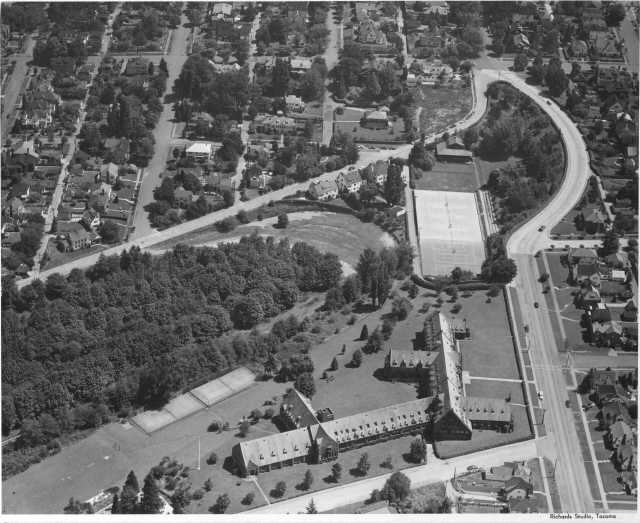

An aerial view of upper Garfield Gulch in 1948, showing where it had been filled by development. Photo courtesy Tacoma Public Library.
Workers building an unidentified sawmill in 1907 show how Garfield Gulch might have looked prior to logging. Photo courtesy Tacoma Public Library.
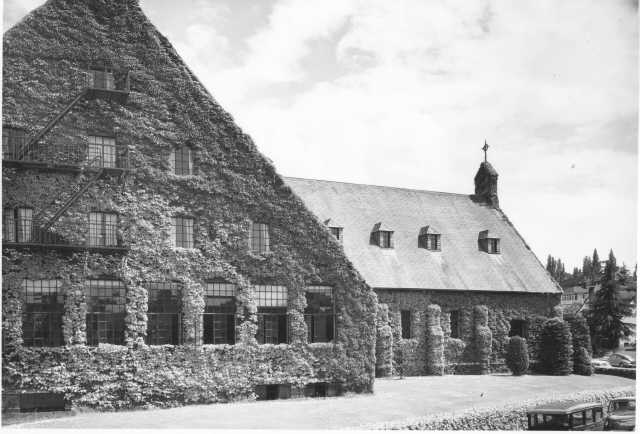
Annie Wright school's Raynor Chapel in 1948, covered with the ivy that would strangle Garfield Gulch. Photo courtesy Tacoma Public Library.
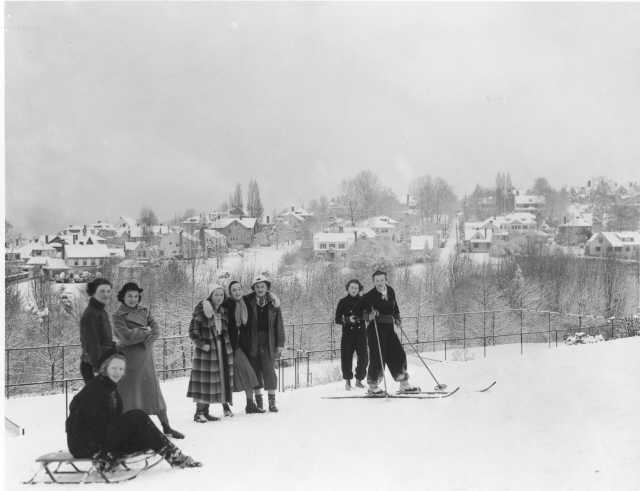
Skiers at Annie Wright school in 1937, with many more trees behind them than are there now. Photo courtesy Tacoma Public Library.
1 – 4
<
>
“I hope you’re wearing good boots,” Girvin warns, and offers a hiking stick.
You need them. As you leave the park on the north side, what you see first is a pleasant gravel jogging trail, cleared and sunny, leading down to Park Drive. This isn’t the track to the gulch, though it’s a credit to Girvin and his teams of volunteers who’ve rescued it from a brambled mess harboring prostitutes and hobos.
No, the gulch track skives off to the right, down a slippery slope to the muddy stream bed 70 feet below, where you feel like Huckleberry Finn as you slosh through wetland, balance-walk fallen tree trunks, clamber over branches and duck blackberries. Of all the gulches, Garfield is the most tangled – a victim of white settlement.
“All but three of the fir trees were cut down,” says Girvin. He points. “There they are. And then people brought in English ivy and blackberry for landscaping. It was a perfect storm for invasion.”
The problem is cyclical. Ivy grows well in shade, creating a blanket that smothers any young native trees. It grows up mature trunks, which get top-heavy and eventually fall in storms. This opens up the forest to bright sun – where blackberry loves to grow and smother saplings.
Add in a type of clematis vine that grows fast in sun or shade, clinging and covering trunks and undergrowth alike like a jungle, plus some deadly nightshade on the stream bed, and the problem seems insurmountable.
Finally, on the upper slopes, you’ll find bizarre patches of philodendron, forget-me-not, knotweed and other ornamentals, thanks to residents who tip yard waste over the side – a cascade of invasion. It’s the visible result of a century of neglect.
“Tacoma’s gulches are a hidden wilderness that is going to waste, and threatened,” Girvin says.
Girvin has been restoring Garfield for over a decade now: first as a father-son project planting fir trees and mounting birdhouses, then more officially with the Green Tacoma Partnership, and finally as a habitat steward overseen by Metro Parks. He leads four work parties a year, clearing invasives and planting natives that he buys himself from nursery sales, but spends most of his free time watering, pruning, and replanting saplings lopped by vandals. One thing he can’t do, though, is restore the foot of the gulch – it’s too steep.
As you go along that foot, intriguing signs of human existence come into view: a dead-branch compost heap made by the Washington Conservation Corps, concrete sewer caps, a cascading waterfall from a storm drain, hollows made by the homeless.
Garfield doesn’t feel as remote as other gulches – you can always hear the yells of playing children at Annie Wright School up above, lawn mowers from the expensive homes lining the rim, or traffic from Schuster Parkway and the railway line ahead. But it still feels wild, with the only footprints that of deer.
As the stream flattens out, though, and Commencement Bay comes into distant view, a different piece of urban archeology emerges: a six-foot wooden pole, carved in the middle. More dot the upper eastside track. They’re markers for the Bayside Trail – one of the biggest impediments, along with the steep slope, to restoring Garfield.
State-funded in the 1970s, the Bayside Trail sounded like a good idea to begin with: a walking trail that ran from downtown along the bluff and up into Garfield Gulch before turning back to the waterfront.
It didn’t work. Hikers got tired halfway, and began wandering through Stadium Way driveways to find a way back. Officials realized that helping anyone who got injured halfway could be difficult. And homeless people discovered it made a handy commute from downtown to a forested living space. The trail was closed – but now, thanks to the new City-Metro Parks partnership, it’s up for discussion again.
Follow habitat steward Rob Girvin as he fights invasives in Garfield Gulch.
“The long-term goal is turning open spaces into useful areas to improve stormwater quality (into Puget Sound) and to give people access,” says Mike Slevin, the city’s environmental services manager. “We want the trail restored and the space used to its full potential.”
Not all locals want the same thing, though. Girvin, who lives on Borough Road, says the folks whose properties back onto the bluff trail think opening it up will just turn it into a thoroughfare for transients and trespassers.
Others, however, would appreciate the waterfront access.
“If you could clean up this section of the trail it would make it more accessible,” says Sandy Zacek, whose home backs onto the gulch but who hasn’t walked her dogs there for a while due to fallen trees and limited sightlines. “I really enjoy the trail on the other side that Rob has taken care of.”
With the Garfield/Schuster management plan only just beginning, it’ll take awhile to see any changes in the gulch. Joe Brady estimates work might begin in five years, while Mike Slevin sees the whole project as a 20-year effort. The first practical step would be putting a boardwalk down the bottom to allow major removal of invasives – a big job.
But for those who care about Garfield, it’s worth the effort.
“Tacoma’s gulches provide more dense space for overwintering birds that wouldn’t breed in residential neighborhoods,” says Audubon Society president Art Young, who birds in Garfield and Puget gulches and has seen dozens of species in each. “They’re a necessary chunk of continuous habitat.”
“The gulches are little gems,” adds Slevin.
Meanwhile, Girvin will keep working in Garfield until something bigger happens. “There’s so much potential here,” he says. “When I look at what they did in Puget Gulch, it’s beautiful. Maybe in 20 years we can have something like that.”
Text, photos, video and design by Rosemary Ponnekanti
Garfield Gulch
Access
Get to either the restored walking trail (leads to Park Drive) or the lower gulch track from Garfield Park, 400 N. Borough Rd. The upper track begins further north down Borough Road and can reach the mouth. Both tracks are steep and slippery. There’s foot access to the gulch’s mouth from Schuster Parkway opposite the Chinese Reconciliation Park, but no car parking.
Explore + Restore
restoration area
Scroll for trails
Mouse for sights
homeless-dug cave
logger springboard stump
Helping
Rob Girvin is the official habitat steward and holds work parties several times a year. To help, contact him at 253-383-4588 or rgirvin@harbornet.com. You can also contact the Green Tacoma Partnership, which manages the habitat steward program, at 253-383-7245 or greentacoma@forterra.org.
restoration area
Garfield Park
restoration area