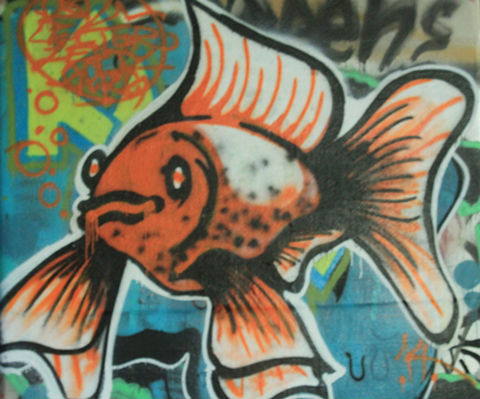
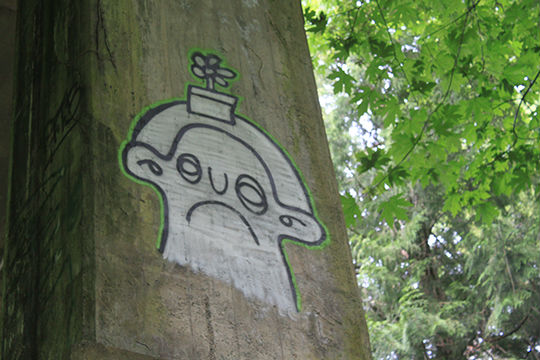
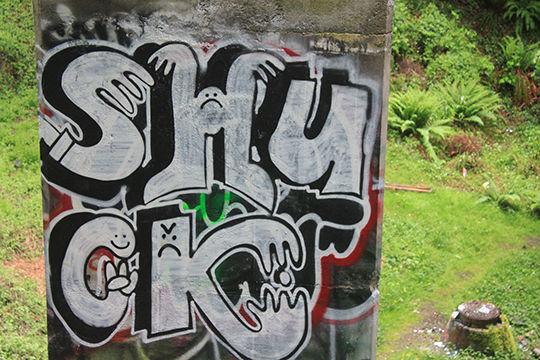
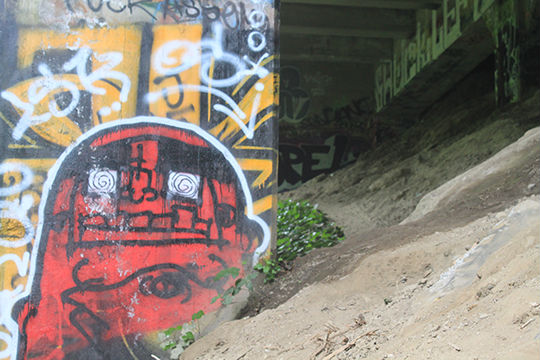
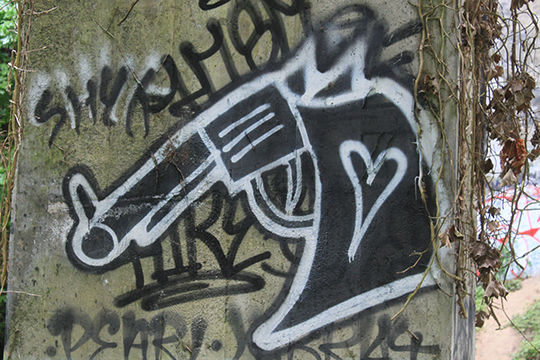
To hike from one end of Buckley Gulch to the other takes wading boots, determination and some courage. It might also help to have a big stick. Because not only will you get deeper and deeper into boggy wetland and thick overgrowth, you’ll eventually make it upstream to the Yakima and North 21st Street bridges, playground of graffitists, drug users and the homeless.
Among all of Tacoma’s northern gulches, Buckley is the wildest – partly due to geography, and partly because half the gulch is privately owned, with no consensus as to how the land gets used. Some locals like it that way. Others want to restore it and open it up as a trail, similar to Puget Gulch. In the meantime, it’s a no-man’s-land that hovers between scary and beautiful.
Buckley – sometimes known as Old Town gulch – is the gulch that doesn’t actually reach Puget Sound anymore. Back in 1864, when first settler Job Carr staked a claim and pitched a cabin on the edge of Commencement Bay, Buckley Creek would have offered him easy fresh water and fish. Over the next few decades as the saw mills moved in to make a killing on Tacoma’s spruce and cedar forests, the creek was used for other things: providing clean steam and a pond for the Dickman mill at the creek’s mouth, and feeding Fullers Domestic Water Works at North 26th and Carr Streets.
In 1925, Ruston Way – the road that skirts the waterfront – was built on wooden beams and fill scooped from the nearby bluff.
“That was probably when the stream was cut off from the Sound,” says photographic historian Ron Karabaich, who grew up making dams and forts in Buckley Gulch sixty-odd years ago and who still lives on its edge.
Now, Old Town Park sits between North 29th and 30th Streets, exactly where the gulch’s mouth ought to be. Until recently it was still boggy, especially in winter. But cross over North 29th and into the little meadow of Ursich Park, and you realize that what looks like someone’s extended back yard is actually the beginning of a gulch – or rather, two.
One extends to the east, a narrow cliff of trees between Carr Street and Orchard Road. Privately owned, the gulch is audible from almost every backyard on Carr Street as a gurgling stream that cascades through just-visible duck ponds and waterfalls.
The other finger of gulch is longer, and traversable – at least for a while. Crossing and recrossing the tumbling, clear stream, the path gets narrower and more tangled with native berries. Expensive houses perch some 170 feet higher up on the edge. A deer carcass, dragged along the path and crawling with maggots, speaks mutely of a coyote that neighborhood groups have been warning pet-owners about. Squirrels dart unafraid; rumors abound that rats also love the thick undergrowth. Birds call constantly; deer wander all around; a field of sharp-tasting watercress grows in the flowing, sandy-bottomed stream. Even the odd car tire is so covered in lush moss that it looks part of the ecosystem.
Most noticeable of all is the quiet. Aside from occasional planes overhead, the bottom of Buckley Gulch seems a thousand miles from anywhere. All orientation is gone, as streets and maps become useless, so far down. It’s a little wilderness, right in the middle of the city.
“This was a wonderful place to grow up as a kid,” remembers Karabaich, who also ventured into Garfield Gulch just a few blocks east. “There are so many little springs – water everywhere. We’d throw mud at each other, dam up the water and float our boats in there, build camps out of scrap lumber and tear them down.”
Kids still play in the gulches. Christina Seeburger, whose house sits between the two fingers of the gulch, says her three boys played and rode mountain bikes down in it regularly without fear.
“When they were little I would accompany them, but I only once saw a stranger coming out of there,” she says.
“Every summer we’d just go down there, play paintball and stuff,” says her son Chris, now a senior. “There used to be a vine we could swing on.”
The trouble with Buckley Gulch comes a little further on. Closer to the footbridge over Yakima Avenue – built originally for the streetcar in the 1890s, now closed to cars – things get stranger. The stream is blocked, and two plastic chairs sit, vacation style, by a stagnant pond. Sewer caps stand like sentinels from a dystopian H.G. Wells novel. Someone’s built a treehouse with a “no trespassing” sign. Another bizarre tree platform has fern fronds hanging from the roofline and “Stay high” spray-painted across the entrance.
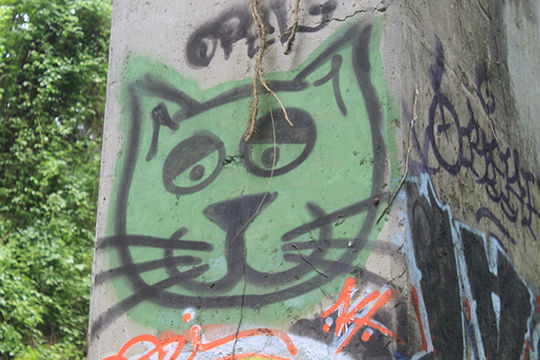
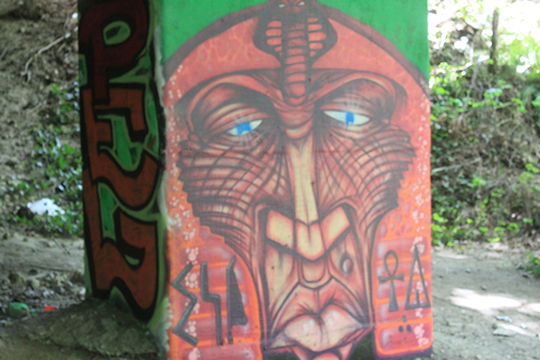
Under the Yakima bridge there’s more graffiti, with spray cans thoughtfully placed in a graffitied garbage bin but plenty more trash lying around (people throw everything from bottles to bicycles off the bridge, locals say). There's a lingering smell of marijuana.
This is all private property, unlike the first few acres near Ursich Park; a city easement along the bottom allows for occasional clean-up but it’s clearly not used much. Ivy covers many of the trees, and will eventually bring them down if not cleared away. Forty years ago a girl, Maria Corsi, was stabbed to death with a pitchfork right here – and it still feels a little haunted.
Follow local resident Renee Paine down Buckley Gulch.
7 – 7
<
>
Graffiti under the North 21st Street and Yakima bridges changes constantly.
If you're exploring down there, keep alert and take a buddy. Be aware that the access (either side of the condominiums on the north-west side of the North 21st Street bridge, or from West Road and Yakima Avenue) is through private property, and very steep.
Under the historic 21st Street bridge, things get nasty – a fireplace, rank-smelling mattresses and clothes, a tent, drug debris.
“We’ve had police with tracking dogs through here, two of our cars broken into, stuff stolen from the back,” says Bill Blaszak. He’s lived in a house just next to the bridge for 37 years, and repeatedly warns kids he sees going down that way to be careful. “There’s always been people under the bridge: a lot of drugs, a lot of sex. We hear it continuously. The police are always very responsive.”
Colin DeForrest, the city's homeless services manager, says they clear out transients several times a year, saying the lack of "positive community activity" makes the gulches challenging.
Steve Hale, who lives between Buckley and Garfield gulches, runs the Old Town neighborhood block watch and volunteers at the local police substation, blames Buckley’s condition on a lack of citizen coordination.
“All open space requires volunteer stewards and a group or two to adopt it and make it thrive,” Hale says. “I have no doubt that some of our petty and not so petty crime is committed by people who use the open spaces as cover and concealment.”
For Hale, and a few other locals, the solution is to restore Buckley and open it up as a public trail, like Puget Gulch or the more recently-restored First Creek. The more regular folks use such a trail, the argument goes, the safer it is for everyone.
“When you see people jogging alone or walking with strollers and dogs you know you are on the right track,” Hale says.
Some neighbors don’t think crime is a problem.
“You could leave a $100 bill on the windshield and it’d be there in the morning,” states Dan Elliott, who grew up on Rosemount Way on Buckley’s west side and whose parents still live there. “My brother and I used to go down there all the time making treehouses, playing games…it was always a peaceful place.”
The problem is, such a trail in Buckley would take the cooperation of some dozen or so landowners along the upper reaches, many of whom have deliberately bought adjoining parcels to keep their property boundaries wild and free of development.
“I wouldn’t want a trail,” says Blaszak, who occasionally goes down the gulch cutting back overgrowth and ivy. “I think there should be green space. A trail would impact the deer and other animals.”
“We see so many here,” adds Blaszak’s wife Eileen. “Squirrels, raccoons, possums, hawks, owls, herons, Western tanagers, hummingbirds. With the trees and wilderness you always feel like you’re on vacation.”
The Blaszaks also say that if you open up a trail, you make it easier for criminals and the homeless to use the gulch: “That’s what happened in Garfield Gulch,” Blaszak says.
There’s another problem with making Buckley a nature trail – development. The property next to the Blaszaks was once forest; four years ago it was converted to a four-storey condominium that still stands empty, no-one wanting dark, under-bridge apartments only accessed by steep stairs.
In January, property owners Jeff and Sarah McInnis began planning for housing on their West Road gulch parcel near the Yakima bridge – three single-family houses on a slope covered with 100-foot firs and fern brakes.
“It’s a really neat little wooded setting (for houses),” says McInnis, who’s lived on Buckley for 15 years.
It's McInnis who built the treehouse; his son built the smaller platform, and all his kids play in the gulch. He says he’d be fine with some public access down there, but that building houses in the gulch would improve things.
“If you put people in the gulch, they can take care of their own area,” he says. “The more people we can get living in there, it’ll improve. If it’s ignored it’ll get rough and wild.”
Others oppose development in the area. “There are plenty of places to build – I don’t know why people have to disturb the gulch,” says Alice Schaffer, who lives close by.
Rick Rosenbladt, Fircrest's city manager and a Buckley property owner, would like the gulch left as it is: "If everything gets developed away," he says, "there's nothing left."
One issue with building on the slope of a gulch is stability. Like all Tacoma’s gulches, Buckley is classified by the City as “unstable,” due to its steepness. No-one has studied the geological stability, says Layne Alfonso of GeoEngineers – it’s all assessed case by case as owners build.
McInnis believes his section is stable enough to build three houses.
Renee Paine, whose house faces the proposed development and who opposes it, disagrees.
“This gulch is dirt – it sloughs,” she says emphatically. “My house is constantly moving down toward the gulch.”
Paine, who has lived on Buckley 46 years and notes that a lot of it has already been filled and built on, is passionate about keeping the gulch green for both people and wildlife. She’d be happy to collaborate with the City to restore Buckley as a safe, public nature preserve.
“It’s a beautiful place that makes Tacoma livable,” she says. “People want beauty around them.”
Buckley’s far upper end shows how neighbors can partner to make a gulch safe and beautiful. While there’s no through access – just south of 21st Street the gulch is filled and blocked by North Oakes Street – it continues, deep and untouched, to its head on North 16th Street, where a few years ago locals built native and community vegetable gardens over the top.
It’s a tranquil public space that’s a world away from the wilderness under the bridges.
“There’s a great opportunity there,” says Joe Brady, manager of natural resources at Metro Parks. “It would be great to connect that neighborhood to Old Town and the waterfront.”
“I would like to see people that live along the gulch – especially the ones that have been victims (of crime) – take ownership of the place, get organized, get support from the City,” says Hale. “Trim it, make a six-foot-wide trail, a place that people want to use. Right now it’s a no-man’s-land.”
Text, photos, video and design by Rosemary Ponnekanti
Buckley Gulch
Access
Public access is through Ursich Park at 2412 N. 29th St. The trail gets boggier and boggier and eventually reaches private property. While it’s possible to access the gulch at the Yakima (off West Road) and North 21st Street bridges (off Anderson Street), it’s private property. The mini-park at North 16th and Junett Streets is public.
Helping
There’s currently no plan to restore Buckley Gulch, but if you’re a local resident you can contact Metro Parks for updates at 253-305-1000 or info@tacomaparks.com. To report crime, call 911 or the non-emergency line 253-798-4722.
Tips
Wear waterproof shoes. Look for watercress in spring/summer. Watch pets – there are sometimes coyote. Be aware under the bridges – take a buddy.
Explore + Restore
Old Town Park
Scroll for trails
Mouse for sights
fresh watercress
graffiti, treehouse
Ursich Park
fresh watercress
graffiti
community park